










Familiar sentence? Sensitive and allergic skin are often described with the same word, yet they are not the same. The symptoms can sometimes be similar, but the underlying processes are different.
Sensitive skin primarily means that the skin reacts more easily to various external factors. In the case of a true allergic reaction, however, the immune system is also involved in the process, and reacts to a specific substance.
This difference is important because it requires a different approach to soothe sensitive skin and a different one to treat a confirmed allergy.
What does it mean that your skin is sensitive?
Sensitive skin does not necessarily mean an allergy. It is more about the fact that your skin reacts with a lower threshold to effects that may not necessarily cause discomfort on other people's skin.
At such times, it may occur, for example:
- tingling or burning sensation,
- tight skin,
- numbness,
- itching,
- occasional redness.
It is important to note that sensitivity does not always have visible signs. Your skin may appear completely normal while you experience an uncomfortable tingling or burning sensation after applying a new product.
What could be behind the sensitivity?
One important factor is the weakening of the skin's protective layer, or barrier.The function of the skin barrier includes helping to retain moisture and protecting the skin from external irritants.
Your skin may be more sensitive, for example:
- in cold, windy weather,
- sudden temperature changes,
- after strong sunlight,
- when using excessively hot water,
- with excessive exfoliation,
- when using strongly foaming or irritating cleansers,
- during more stressful periods.
Sensitivity can also occur with certain skin issues, such as rosacea or atopic dermatitis, and excessive use of active ingredients can weaken the skin's protective barrier.
And what does it mean to have an allergic reaction?
“Allergic skin” is actually not a standalone skin type.
We talk about an allergy when the immune system mistakenly perceives a certain substance as dangerous, and initiates an immune response against it. In the case of cosmetics, one common form of this is allergic contact dermatitis.
Interestingly, an allergy can develop even after years of problem-free use. The immune system can "remember" the substance from a previous encounter, and during a later contact, it can trigger a reaction.
Common triggers in cosmetics can include certain:
- fragrance substances,
- essential oils,
- preservatives,
- and components found in hair dyes, such as PPD.
Sensitivity or allergy? These can help you navigate
| Characteristics | Sensitive skin | Allergic reaction |
|---|---|---|
| What is behind it? | Weakened skin barrier and increased reactivity | The immune system's reaction to a specific substance |
| Typical symptoms | Stinging, burning sensation, tightness, occasionally redness | Severe itching, redness, swelling, blisters, eczema symptoms |
| When does it occur? | Often shortly after the triggering effect | Often delayed, even 1–3 days later |
| Where does it occur? | Primarily where the skin was affected | It can spread beyond the affected area |
| Can it change over time? | Yes, it can improve with the strengthening of the skin barrier | The allergy to the specific allergen may persist permanently |
| How can it be tested? | Based on symptoms and medical history | With a dermatological examination, and if necessary, a patch test |
The symptoms can naturally vary from person to person, so the table is more of a guideline, not a diagnosis.
There is a third option: irritation
Not every unpleasant reaction is an allergy.
The irritant contact dermatitis can occur, for example, when a substance is too strong, used too often, or comes into contact with the skin for too long. This can happen to anyone under the right conditions, but those with sensitive skin may have a lower irritation threshold.
A typical example could be when the skin:
- turns red,
- feels tight,
- starts to peel,
- produces a burning or stinging sensation.
In this case, it does not necessarily mean that you are "allergic" to the product.It may simply be that there was too much for your skin.
How to care for sensitive skin?
For sensitive skin, the “less is more” principle generally works best.
There is no need to use ten different products. A simple, consistent routine that supports the skin's protective barrier is much more important.
1. Choose a gentle facial cleanser
Cleaning is important, but with sensitive skin, the goal is not to have the skin feel tight or “squeaky clean” after use.
The Maruderm Gentle Facial Cleansing Gel for Sensitive Skin is a gentle formula specifically designed for sensitive skin. It hydrates and cleanses the skin and can also be a suitable choice for atopic skin.
Tip: cleanse your face with lukewarm water and avoid excessive rubbing.
2. Support the skin barrier
One of the most important steps for sensitive skin is proper hydration and supporting the skin's protective layer.
The Maruderm Skin Protecting and Regenerating Barrier Moisturizer contains 5% panthenol and 1.5% ceramide. The formula also includes hyaluronic acid, niacinamide, allantoin, and squalane, and is free from fragrance, parabens, SLES, and SLS.
This can be an especially good choice if your skin feels dry, tight, or easily irritated.
3. If you are looking for a more soothing formula, check out Centella
Centella asiatica, or Cica, is a common ingredient in formulas designed for sensitive skin.
A Maruderm Centella Soothing Moisturizer Contains Centella Asiatica, niacinamide, hyaluronic acid, allantoin, and panthenol. According to the webshop, it is particularly suitable for skin prone to sensitivity or dryness, and it does not contain perfume, parabens, SLES, or SLS.
4. Don't forget about sun protection!
Daily sun protection is an especially important part of your routine for sensitive skin.
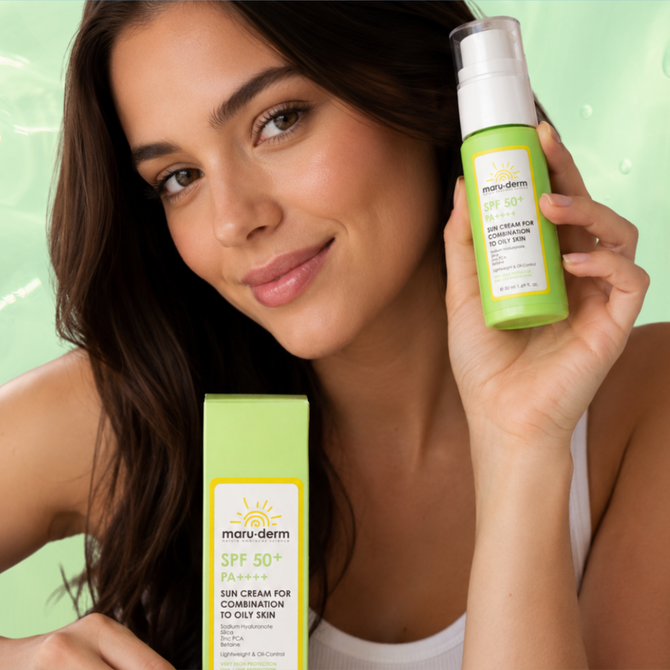
A Maruderm SPF 50+ 100% Mineral Sunscreen Uses 100% mineral filters, provides SPF 50+ and PA++++ protection, and is suitable for sensitive skin according to the webshop. The formula also contains zinc oxide, panthenol, hyaluronic acid, and allantoin.
What to do if your skin reacts badly to a new product?
One bad reaction does not automatically mean that you are allergic to one of the ingredients.
If you are trying a new product, especially with sensitive skin, it is advisable to:
- first test it on a small area of skin,
- not introduce multiple new products at once,
- monitor when and what symptoms occur,
- stop using the product in case of an unpleasant reaction.
We also recommend that for sensitive skin, you test new products individually on a small area of skin for a few days before incorporating them into your full routine.
When is it advisable to consult a dermatologist?
If the reaction is strongly itchy, blistering, oozing, or accompanied by swelling, it is advisable to seek the help of a dermatologist.
The same is true if:
- your skin reacts to almost every new cosmetic,
- the symptoms do not improve after discontinuing the product,
- the same reaction recurs every time,
- the redness persists,
- or you cannot determine whether it is irritation, an allergy, or another skin problem.
In case of suspected allergy, the dermatologist can also help determine exactly which substance your skin reacts to with a patch test.
And what about the label "hypoallergenic"?
The term "hypoallergenic" does not mean that a product is guaranteed not to cause allergic reactions.
The term indicates that the product has been developed with the aim of reducing the risk of allergic reactions, but there is no cosmetic that is guaranteed to be allergen-free for everyone.
If you already know that you are allergic to a certain ingredient, it is always worth checking the ingredient list (INCI) .
In summary
There is an important difference between sensitive skin and allergic skin.
Sensitive skin cases can primarily cause unpleasant reactions due to the lower threshold of skin sensitivity and a weakened skin barrier.
In the case of allergies , the immune system reacts to a specific substance, and the symptoms can often be accompanied by more intense itching, eczema-like changes, or swelling.
Therefore, it is not advisable to automatically label every skin reaction as "allergy." At the same time, a recurring or strong reaction should not be dismissed as mere sensitivity.
The most important thing: pay attention to your skin's signals, do not introduce too many new products at once, support the skin barrier, and if necessary, seek the help of a dermatologist.